
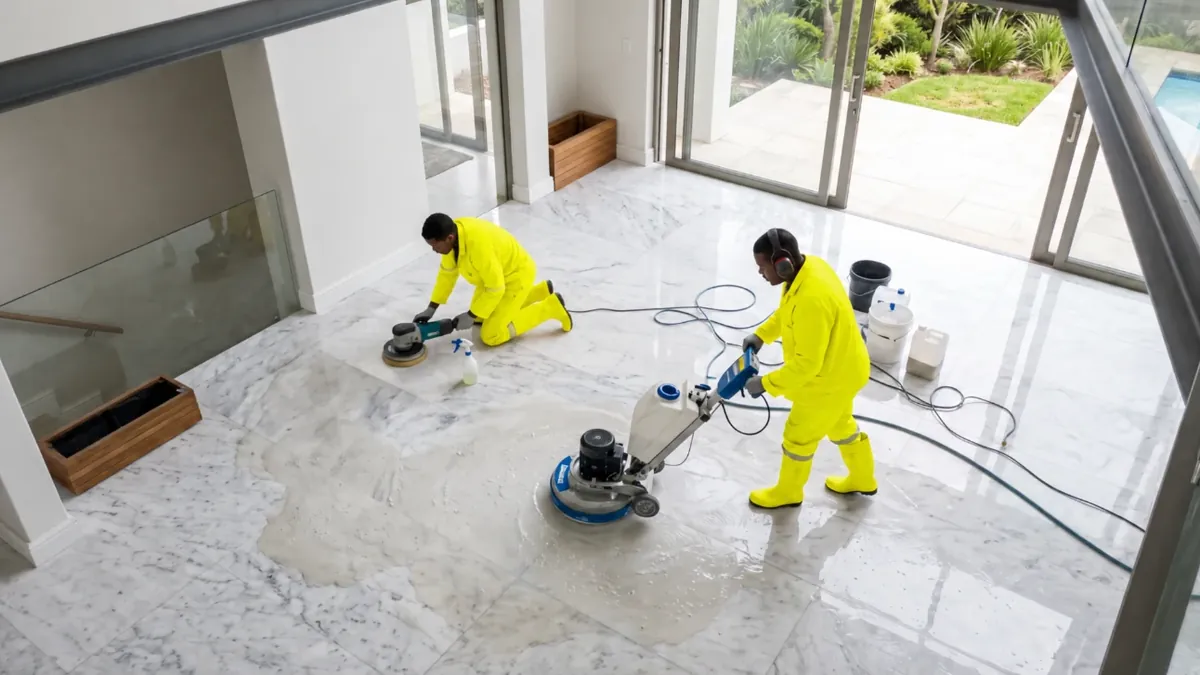
Is the old floor out?
Natural Stone Flooring South Africa is quoted in two halves that are worth keeping apart: the stone by the square metre, and the laying by the square metre. The stone can be anything from an inexpensive limestone to a marble that costs five times as much, while the laying rate barely moves. Say the square metres, which rooms, and whether the old floor is still down.
Super easy & fast
- Know the supply rate and the laying rate apart, so you never pay too much.
- Send the same square metres to several stone specialists, and quotes come back fast.
- From LEADERR APPROVED providers, vetted and backed by many verified 5-star reviews. Peace of mind that the screed and the levels are checked before laying.
Give the square metres and get stone floor quotes.
Get the Best QuoteNatural Stone Flooring Prices
Ballpark figures so you can check a quotation.
| Item | Ballpark price |
|---|---|
| Limestone supplied, per square metre | R350 - R900 |
| Travertine supplied, per square metre | R350 - R950 |
| Marble supplied, per square metre | R450 - R1,500 |
| Granite supplied, per square metre | R550 - R1,600 |
| Laying labour, per square metre | R250 - R650 |
| Adhesive, grout and sundries, per square metre | R90 - R220 |
| Lifting an old tiled floor, per square metre | R120 - R350 |
| Levelling screed where needed, per square metre | R150 - R400 |
| Skirting cut from the same stone, per metre | R200 - R650 |
| Sealing the finished floor, per square metre | R80 - R220 |
Prices JUST UPDATED. Ballpark figures, rounded, excluding VAT. They reflect typical South African stone fabrication and restoration rates. They are not our prices or quotations, and no provider is bound by them. Stone is quoted on the MATERIAL and on the SQUARE METRES, the METRES OF VISIBLE EDGE and the CUT-OUTS that go with it, so confirm what each quotation includes, such as the site visit and template, the slab itself, the edge profile, every cut-out, delivery and carrying it in, the fitting, the sealing, and whether taking the old surface away is in the figure.
The Stones People Use Underfoot
- Marble. The brightest, and the one that polishes to a mirror.
- Limestone. Softer and quieter, usually honed rather than polished.
- Travertine. Warm and pitted, filled or left open, good outdoors.
- Granite. The hardest wearing, and the usual choice in entrances.
- Slate and quartzite. Textured, dark, and not slippery when wet.
What Has To Be Right Underneath
- The screed. Level and sound, or the stone telegraphs every dip.
- Movement joints. A large floor needs them, and they are left out too often.
- The adhesive. Stone needs the right one, and a white one under pale stone.
- The thickness. A thicker stone changes every door and threshold height.
- Damp. A rising damp problem under a stone floor only gets worse.
Finishes and How They Wear
- Polished. Brightest, shows scratches soonest, slippery when wet.
- Honed. Matt, hides wear, and the usual choice for a busy house.
- Brushed or tumbled. Texture underfoot, and forgiving in a kitchen.
- Filled or unfilled. On travertine, which decides how it cleans.
- Sealed. Not a finish, but it decides how the floor copes with spills.
Get a price for your own rooms rather than a range.
Get the Best QuoteWhat Affects the Price
- Which stone. The supply rate varies more than everything else combined.
- The square metres. Bigger floors carry a better rate per metre.
- The state of the sub floor. A screed that needs levelling adds a real line.
- The tile size. Large format needs a flatter base and more hands.
- Cuts. A room full of angles and thresholds is slower than a square one.
- Whether the old floor comes up. Lifting and carting away is often quoted apart.
What to Include in Your Request
- The address. Suburb and town, so you reach specialists who work there.
- The square metres. Room by room if you can, roughly is fine.
- Which stone you want. Or say what look you are after and ask for options.
- What is down now. Tiles, screed, timber or carpet.
- Whether anyone is living there. It changes how the work is staged.
- Photos. Each room, and a close one of the existing floor.
Before the Stone Is Ordered
- Ask for supply and lay separately. It is the only way to compare two quotes.
- Ask about wastage. Ten per cent over is normal, and more on a diagonal lay.
- Ask about the batch. Order the whole floor at once, from one batch.
- Ask about door heights. A thicker floor means doors have to come off and be trimmed.
- Ask about movement joints. Where they will fall, before you see them.
- Ask who seals it. And when, because it is usually after the grout cures.
Natural Stone Flooring FAQs
How much does a natural stone floor cost in South Africa?
Supply runs from about R350 a square metre for limestone and travertine to R1,500 for marble and R1,600 for granite, and laying is commonly R250 to R650 a square metre on top, plus around R90 to R220 for adhesive and grout. A 40 square metre living area in a mid range stone therefore comes to roughly R30,000 to R70,000 laid, before lifting an old floor.
Which natural stone is best for a floor?
It depends on the room. Granite and quartzite are the hardest wearing and suit entrances and high traffic. Marble is the brightest but is softer and scratches, so it does better in formal rooms than in a back door passage. Limestone is quiet and warm underfoot and is usually honed. Travertine works indoors and is one of the few that is comfortable outdoors as well.
Is a stone floor slippery?
A polished one is, when it is wet, which is why bathrooms and outdoor areas are normally honed, tumbled or brushed instead. Finish matters far more than the stone itself. If a floor has already been laid polished and is a problem, it can be honed down on site rather than replaced.
Can stone go over an existing tiled floor?
Sometimes, if the old tiles are sound, well bonded and the extra height does not cause problems at doors and thresholds. More often the old floor comes up, because a tile that is already loose will take the new one with it. Expect a specialist to want to check a few tiles by sounding them before committing either way.
How long does it take to lay a stone floor?
Roughly 15 to 25 square metres a day for one team on a straightforward room, so most houses are a matter of days rather than weeks. Lifting an old floor, levelling the screed and letting adhesive and grout cure add to that, and the sealer usually goes on a few days after the grout.
The supply rate and the laying rate move independently, and Marble Services South Africa is the quickest way to see both from several specialists at once.
Related Services
Get the Best Quote, Fast
Client Reviews
Powered by leaderr